
Frequently asked questions
No matching questions. Try another search or contact us.
Which product do I need — NPK or CalciMag?
Purdys NPK 3-Part is our complete base feed. It already supplies phosphorus (P), potassium (K), calcium and magnesium, so additional CalciMag supplementation is not normally needed when it is used as recommended.
Our standalone CalciMag can be used to supplement other products where additional nutrients are required. If you are unsure which product to choose or how it fits with your existing products, contact us.
Why does Purdys use less phosphorus (P)?
Our formula uses less phosphorus than many other nutrient products. Phosphorus is essential, but supplying more than a plant needs does not automatically improve growth or yield. Research has shown that lower phosphorus levels can maintain growth and yield when the crop’s requirements are still met.
Avoiding excess phosphorus also helps limit unnecessary salt loading in the root zone. Lower overall salt concentrations reduce osmotic pressure, making it easier for roots to take up water.
The right amount depends on the crop, growth stage and growing conditions. Use our NPK calculator to check your feed rather than adding extra phosphorus automatically.
Further reading: Phosphorus supply and yield in a high-CBD cannabis variety — full study · Nutrient concentration and osmotic stress.
Which growing media are Purdys products suitable for?
Purdys products are suitable for most growing media, including coco coir, hydroponic systems and soil. Our range is particularly suited to coco coir and hydroponic growing.
What’s the difference between salts and liquid?
The salts let you prepare the concentrate yourself by adding water. The liquid products are supplied as ready-made concentrates. When prepared to the correct final volume, the salts make the same concentrate as the corresponding liquid product.
Both forms must be diluted into your final feed water before use.
Does a 1L salts pack make 1L of concentrate or 1L of feed?
A 1L salts pack makes 1L of concentrate, not 1L of ready-to-use feed. The NPK 1L set contains three separate parts: Part 1 makes 1L of concentrate, Part 2 makes 1L, and Part 3 makes 1L. That is 3L of concentrate in total, kept in three separate containers.
The NPK 1L set makes approximately 450L of final feed at our recommended dose. You can use a higher or lower dose to suit your requirements; this changes how much feed the set will make.
For standalone CalciMag, the amount of final feed depends on the dose you use. Use our NPK calculator or CalciMag calculator to explore your chosen dose and water volume.
How do I mix the salts into a concentrate?
Mixing instructions
Add each pack of salts to its own suitable container. Add water and mix, topping up to the final concentrate volume stated on the pack. Allow the salts to dissolve before use.
For NPK 3-Part, prepare Parts 1, 2 and 3 in separate containers. Do not combine the dry salts or the prepared concentrates with each other.
Safe handling
Avoid contact with dry salts and concentrated liquids. Wash your hands if contact occurs. Protect your eyes and take care to avoid splashes when preparing concentrates or dosing. If the product gets into your eyes, immediately rinse with clean water and seek medical or emergency advice.


How do I mix Purdys NPK into my final feed?
Add equal amounts of Part 1 and Part 2 to your feed water, using the recommended dose or a custom dose suited to your requirements. Add each part separately and mix thoroughly before adding the next.
Part 3 may be added during fruiting for extra phosphorus (P) and potassium (K), but this is not always necessary. Use the NPK calculator to work out your additions when using Purdys NPK 3-Part.
Check the final feed’s pH after mixing and adjust if needed.
Can I mix the concentrates together?
No. Do not mix dry salts or undiluted liquid concentrates together. Keep each product and each part separate.
Mixing a calcium-containing concentrate directly with a sulphate-containing concentrate can form calcium sulphate, which separates from the liquid as a solid deposit. The photo below shows the deposits formed by mixing Parts 1 and 2 directly.
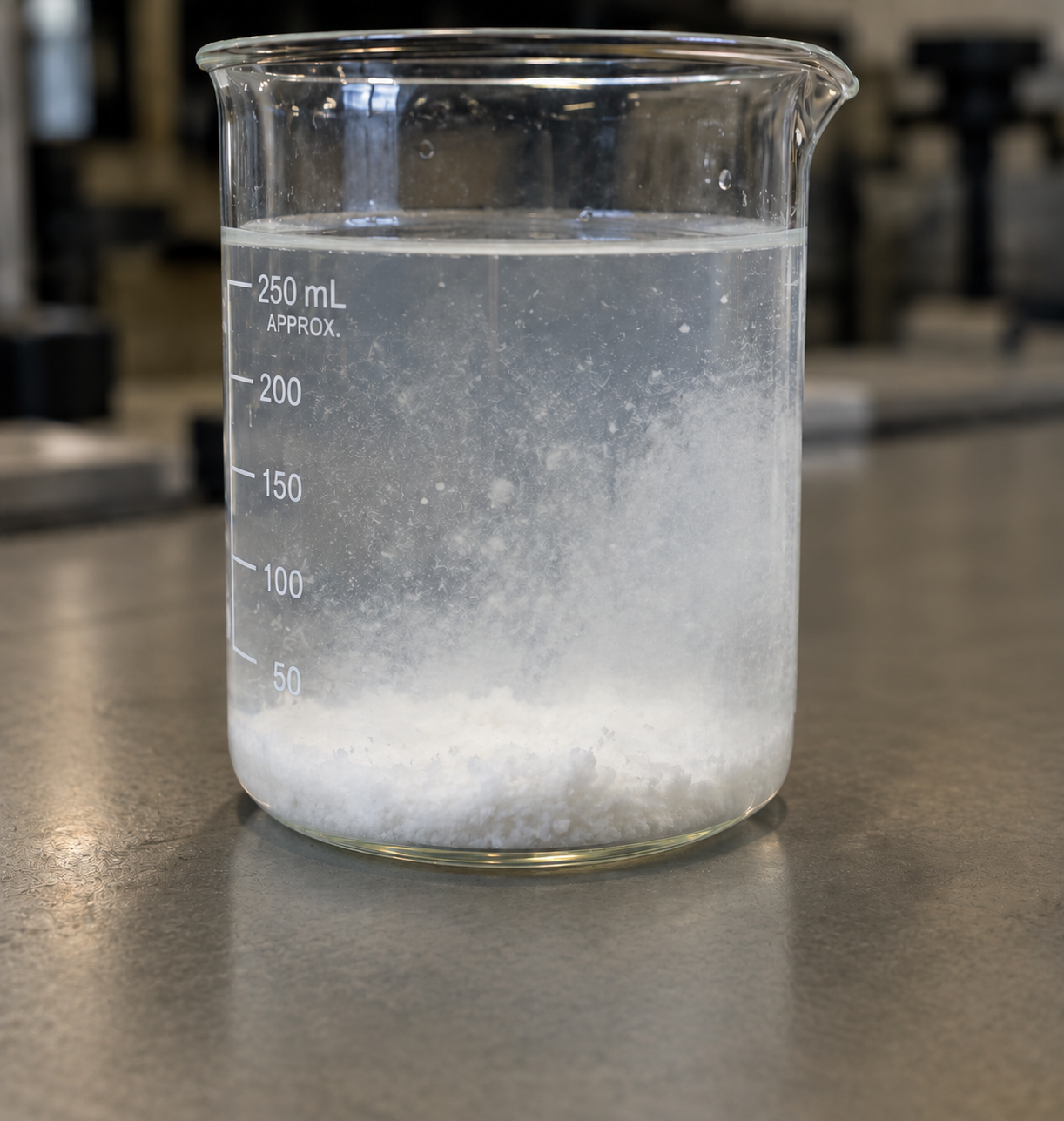
Do not use a mixture that develops visible clumps or solid deposits like those shown after mixing concentrates together. Contact us if you are unsure.
To prepare your final feed, add each compatible concentrate separately to the feed water, mixing thoroughly before adding the next. This applies to Purdys and other products.
Can I use tap water?
Yes, you can use tap water. If your water is hard or very hard, consider using reverse osmosis (RO) water.
The NPK calculator lets you include the nutrient levels already present in your tap water when those values are known.
How should I store and use liquid concentrates?
Store both ready-made liquids and concentrates prepared from DIY salts in opaque containers. If using clear containers, keep them in a dark place away from light.
Store liquid concentrates above 10°C where possible. If a product has been stored below this temperature, allow it to warm above 10°C before use.
Do not use the concentrate below 10°C. Our products are highly concentrated, and some salts may not remain fully dissolved at lower temperatures.
Shake thoroughly before every use. Minor settling or separation may occur between uses; allow any undissolved salts to dissolve again before measuring your dose.