Growers Hub
No matching sections. Try another search or contact us.
pH
For many crops grown in hydroponics and coco coir, a nutrient solution pH of 5.5–6.5 is a suitable general range, with 5.8–6.2 a good target. The best pH depends on the crop, but keeping it within a suitable range helps plants access the nutrients they need.
To keep your pH meter reading accurately, rinse the probe after use and store its sensing tip in KCl storage solution. Do not let the tip dry out or store it in distilled or RO water.
Calibrate regularly using fresh pH 4 and pH 7 buffer solutions.
Tap water & source water
Your starting water contributes to the final nutrient mix. Tap water can already contain calcium, magnesium and other dissolved minerals, so include these in our calculators where you know the amounts. UK water suppliers provide water-quality reports for your area, often through a postcode search on their website. These usually show typical or average readings.
Well water, borehole water and collected rainwater can vary in quality, so have them tested rather than assuming they are suitable. Some supplies contain enough dissolved minerals to make them unsuitable for your intended feed without treatment.
Reverse osmosis (RO) water contains very few dissolved minerals, giving you more control over your nutrient mix.
Electrical conductivity (EC)
EC is a useful guide to overall nutrient strength, but it does not reveal which nutrients are present or how much of each the solution contains. Two solutions can both read 2.0 mS/cm yet have very different nutrient compositions. One could contain much more nitrogen and calcium, while the other contains more potassium and phosphorus. The same EC reading does not mean the same feed.
Calculating the concentration of each element gives a clearer picture of your nutrient mix. These values are expressed in ppm (parts per million). In dilute nutrient solutions, 1 ppm is approximately 1 mg/L—one milligram per litre.
Use our Purdys NPK and Purdys CalciMag calculators to calculate the elemental nutrient levels supplied by your chosen doses and final solution volume. Include the nutrients already in your source water for a fuller picture.
These elemental values are different from a meter’s “ppm” or TDS reading, which is usually calculated from EC.
Elemental nutrients explained
Elemental values tell you how much of each nutrient is actually in your feed. Fertiliser labels often use a different measuring system that makes phosphorus and potassium numbers look higher. For example, a label showing 10% P₂O₅ contains about 4.36% phosphorus. Our calculators show the actual nutrient amounts so they’re easier to understand and compare.
Coco coir
Coco coir is an excellent growing medium that can support rapid growth with the right balance of water, air and nutrients. Keeping the root-zone pH within a suitable range helps plants access the nutrients they need.
Coco does not provide a complete, balanced nutrient supply. For established plants grown in unamended coco, routine irrigation should normally contain a balanced nutrient solution suited to the crop and growth stage. Watering with nutrients is also known as fertigation. Coco is not completely inert: it can hold and exchange nutrients, so use properly prepared, buffered coco.
Comparing the EC of your nutrient solution going in with the runoff coming out can help you track changes in the root zone. A rising runoff EC does not automatically mean the plant has stopped taking up nutrients. As plants use water and the medium dries, the remaining salts become more concentrated, raising EC. Larger plants and a higher vapour pressure deficit (VPD) can increase water demand and make coco dry faster than expected.
Additional lighting, including under-canopy lighting, may also increase plant water demand. Check how quickly the coco dries after changes to lighting or growing conditions, and adjust irrigation frequency and volume to match. More frequent irrigation may be needed, but base changes on moisture levels, runoff trends and plant condition rather than a single EC reading.
Buffering coco
We recommend using properly buffered coco coir. Unbuffered coco can hold onto calcium and magnesium from your feed while releasing potassium and sodium, creating nutrient imbalances that can affect your plants. Washing removes soluble salts, while buffering loads the coco’s exchange sites with calcium and magnesium, replacing much of the potassium and sodium held there.
Check how your coco has been prepared rather than assuming that every bag or brick is ready to use. Both loose coco and compressed bricks can be buffered before planting. Bricks do not automatically need a stronger solution—the treatment needed depends on the coco’s condition and previous processing.
To buffer untreated coco, hydrate it fully, rinse away soluble salts, then submerge it in a calcium and magnesium solution prepared at an appropriate buffering strength. We recommend a 12-hour soak for each buffering treatment. Depending on the coco’s condition, a second soak in fresh solution may be needed. Drain and rinse between treatments and afterwards to remove displaced salts and excess solution.
Purdys CalciMag supplies calcium and magnesium for preparing a buffering solution. Use an appropriate buffering strength; a stronger solution is not automatically better.
If your water has low alkalinity, acidity in the coco can cause the pH to drop more easily. While preparing and buffering your coco, monitor the solution’s pH. If it drops below your target range, add small amounts of pH Up, mix thoroughly and allow time before checking again. You may need to repeat this as the coco and solution settle. Correcting acidity is separate from buffering with calcium and magnesium.
Indoor lighting, PPFD & DLI
PPFD measures how much light useful for photosynthesis reaches your plants each second, expressed in µmol/m²/s. For some high-light crops, building up to around 650 PPFD during established vegetative growth and around 1,000 PPFD during flowering can be suitable. These are guide figures, not universal targets: the right intensity depends on the crop, growth stage and daily lighting hours.
Supplemental CO₂ can help plants make use of higher light levels when temperature, water and nutrition are also suitable. However, increasing light does not guarantee a matching increase in growth or yield, and additional gains can diminish at higher intensities.
Modern LEDs generally deliver less infrared heat to the leaves than HPS lamps, so leaf temperatures can be lower at the same room temperature. A warmer room may be needed to maintain a suitable leaf temperature. Check leaf temperature rather than raising the room temperature automatically.
DLI (daily light integral) is the total amount of light useful for photosynthesis your plants receive over a day. It combines light intensity with how long the lights are on. Use the calculator below for a constant light intensity.
DLI calculator
DLI: mol/m²/day
Vapour pressure deficit (VPD)
A lower VPD means wetter, more humid air, so plants generally transpire less. A higher VPD means drier air, so plants generally transpire more.
A VPD around 1.0 kPa can be a useful starting point for vigorous growth in established plants. The best target depends on the crop, growth stage and growing conditions. Higher is not always better: excessive VPD can cause plants to close their stomata, reducing transpiration and growth.
VPD calculator
Leave leaf temperature blank to calculate air VPD. Enter it to calculate leaf VPD.
Air VPD: kPa
Negative leaf VPD means condensation can form on the leaves.
Nutrient deficiencies & toxicities
Clones, cloning and seeds
Seeds and clones have different nutritional needs. Seedlings generally need a lower nutrient concentration, while rooted clones can handle a stronger feed, gradually increasing towards the strength used for the mother plant as they establish.
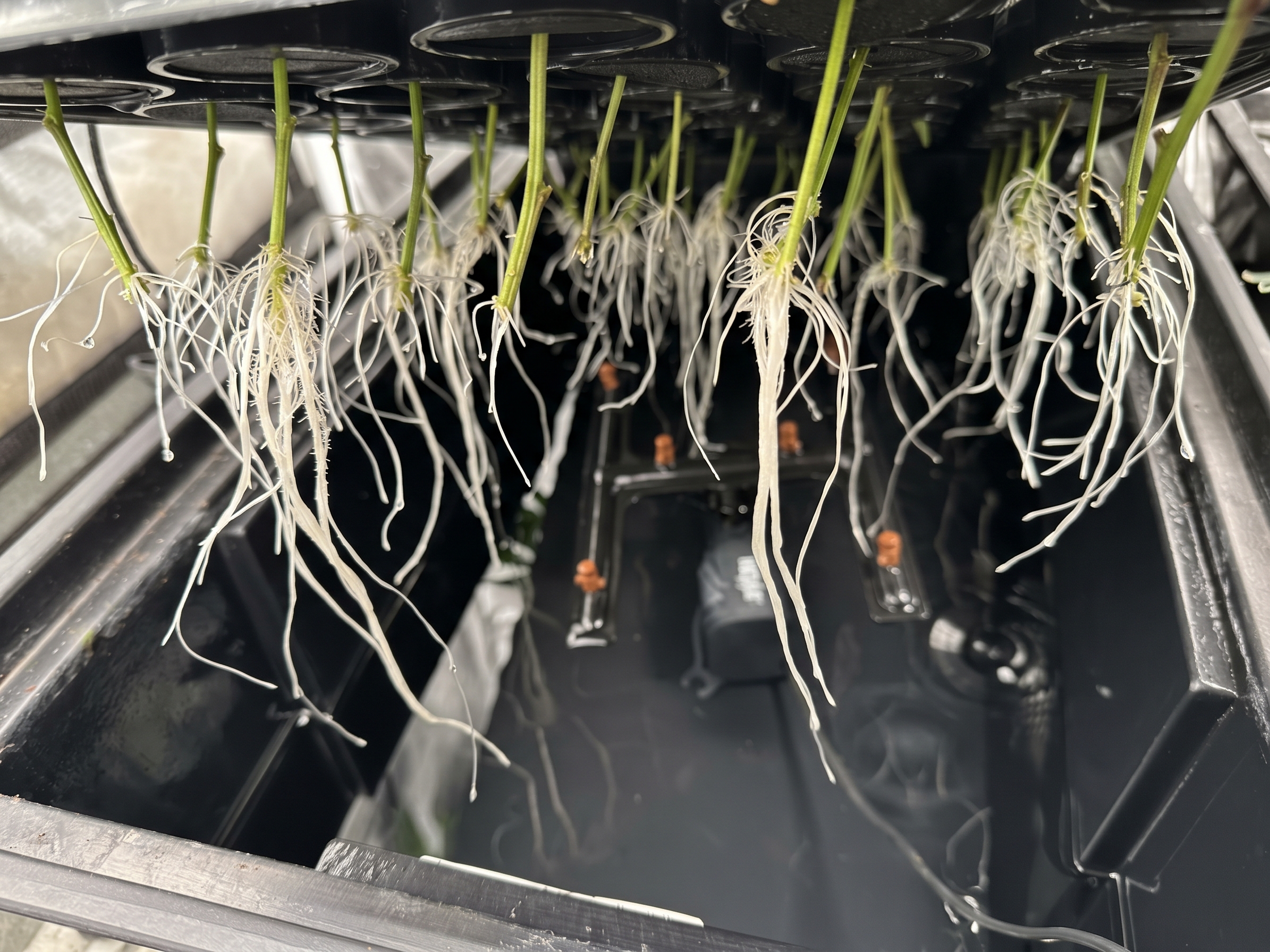
We recommend aeroponic cloning to develop a strong root system before transplanting. It also gives you the flexibility to transplant into soil, coco coir, hydroponics and other growing systems.